 Monolith Analytics
The canvass with no candidate attached
The biggest outside canvass in Nebraska's Senate race cost $2.4 million and appears in no report as spending for any candidate.
This fall, canvassers came to my door. My neighborhood is one of the poorest in the state. They were young, and they weren’t very good at it. They asked about Dan Osborn, and they left literature that said “Independent for Senate.” It mentioned no party and no other race. At the bottom it read: PAID FOR BY WORKING CLASS MAJORITY PAC.
You won’t find that canvass where you’d look for it. Working Class Majority PAC reported millions in independent expenditures for Osborn, which is the category the FEC uses for spending that supports or opposes a candidate. TV, digital ads, mail, phones and texts are all there. Canvassing isn’t. The canvass is in a different part of the PAC’s reports, on the line for “other disbursements”: seven payments between August 11 and October 14, totaling $2,435,000, to a canvassing firm, The Outreach Team Inc. The description on each payment reads “Canvassing Non IE – Non Contribution Account.”
“Non IE” means the PAC says the canvass was not an independent expenditure. “Non Contribution Account” means it was paid from the account that can take unlimited money. Put together, the largest outside field program in the race is recorded as an ordinary operating cost, with no candidate attached.
Why that’s allowed
In March 2024 the FEC issued Advisory Opinion 2024-01, in response to a request from Texas Majority PAC. It concluded that paid door-to-door canvassing is not a “public communication” under the agency’s coordination rules. An outside group can therefore pay canvassers and consult with a candidate’s campaign about the canvass, its scripts and literature included, without the canvass itself counting as a contribution to that campaign. (Handing the campaign the data the canvass collects is different: below market value, that can be an in-kind contribution.) One law firm’s memo to clients read the opinion as opening the door to paid canvassing programs that support federal candidates and are paid for with unlimited money. Campaign Legal Center sued the FEC over the opinion on May 6, 2026.
Whether this canvass was coordinated with Osborn’s campaign isn’t something the filings say. The point is that the rules no longer require anyone to say. A canvass can be built for one candidate and paid for with unlimited money, and the only public record is an operating line on a PAC’s report.
Who paid for it
Working Class Majority PAC raised most of its money from a short list of organizations and PACs:
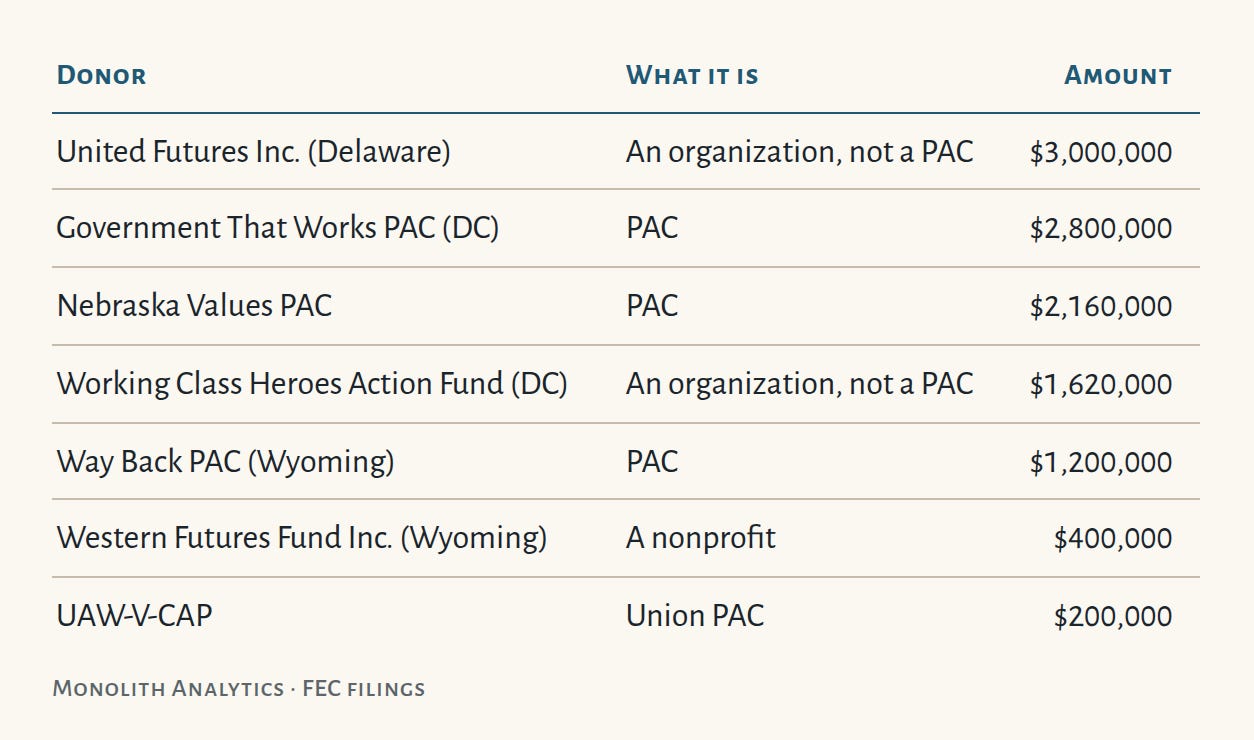
About $5 million came from organizations that aren’t registered PACs, so their own donors don’t appear in FEC filings. The Working Class Heroes Action Fund’s name echoes Osborn’s own PAC, the Working Class Heroes Fund, though the filings don’t show any formal connection between the two. Osborn’s PAC itself took $450,000 from Contours Inc. (a Delaware 501(c)(4)) and $350,000 from American Opportunity Action, a Washington group founded in 2025. Whoever ultimately paid for the knocking on my door, the reports don’t let a voter find out.
What the money bought
Here’s all the reported spending on the Senate race, for and against Osborn, with each transaction counted once:
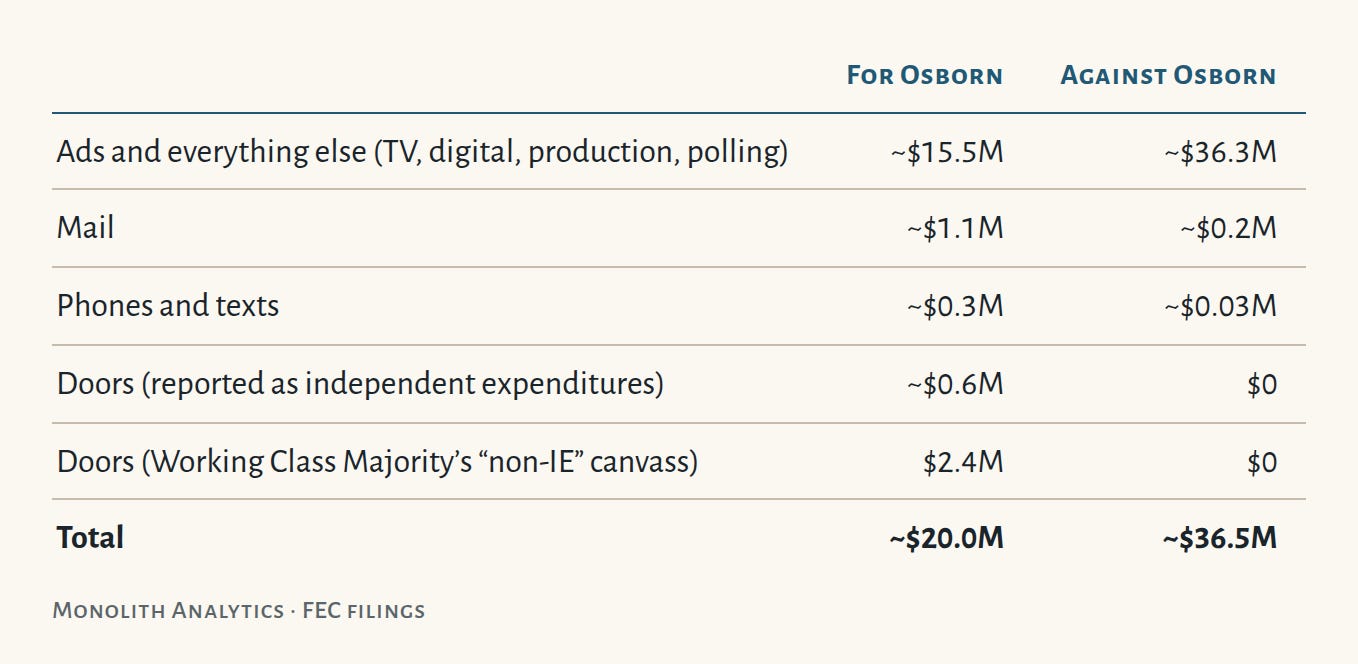
Both sides fought an air war. Republican-aligned groups outspent Osborn’s side by nearly two to one and reported no door program against Osborn at all. On Osborn’s side, about $3 of every $20 went to doors, and four-fifths of that door money ran through the program nobody reported as being for Osborn.
What came with it? A close race in a state Trump carried by about 20 points: Osborn lost by 6.2. But most of that closeness was already there. Counting only the two main candidates, Osborn lost by 6.7 points in 2024 and by 6.6 in 2026: in a year when the national environment moved hard toward Democrats, the race moved a tenth of a point.
How Osborn compares
With Democrats in other states. Here are the nine Trump states where a Democrat won the Senate race this year, with Nebraska beside them, measured two ways: the swing from Trump’s 2024 margin to the 2026 Senate result (two-party), and how many of each side’s presidential voters each candidate held.
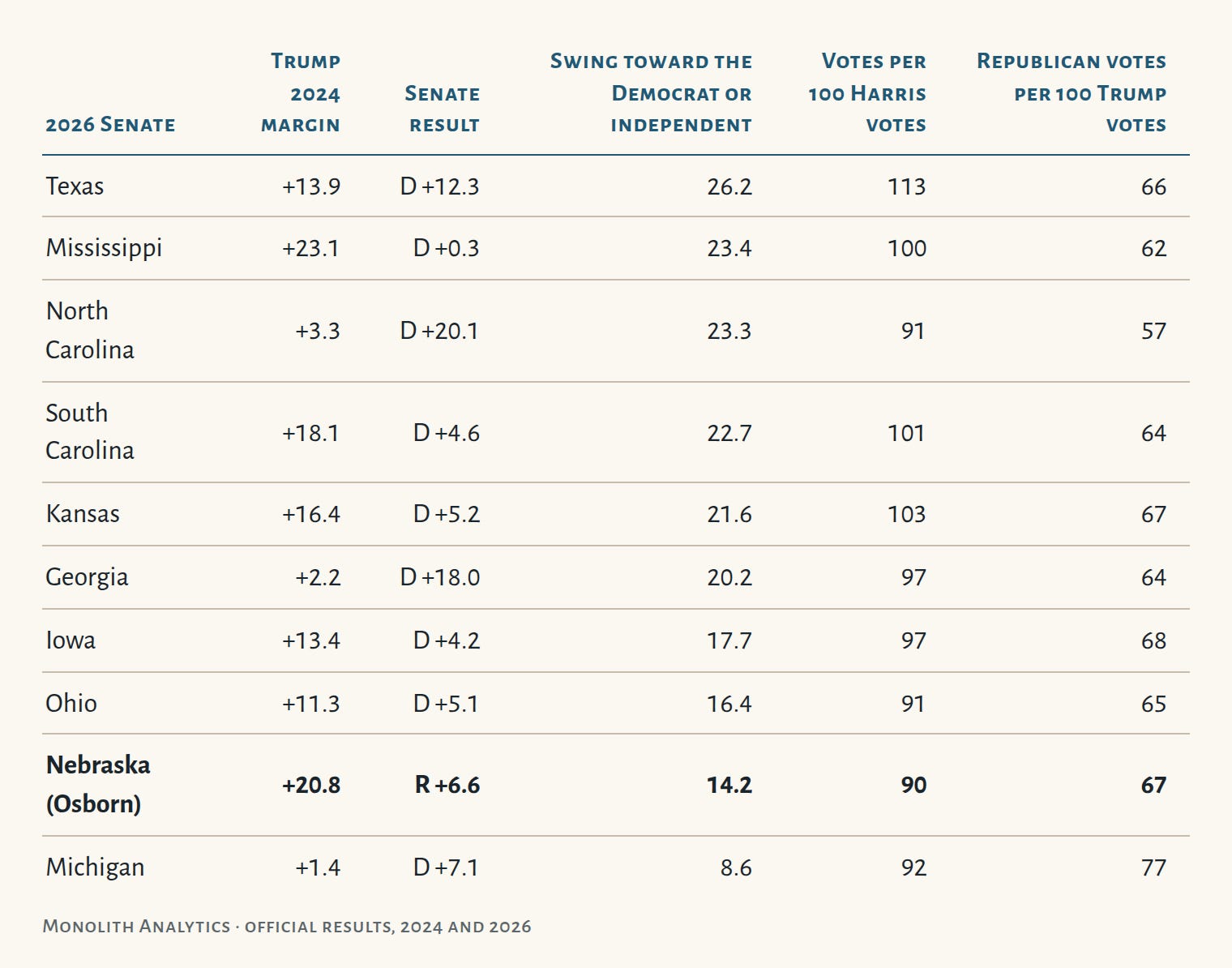
Across all 19 other Trump states with a Senate race, the median swing was 19.1 points and the median candidate held 94 votes for every 100 Harris won. Nebraska swung 14.2 and Osborn held 90, 17th of 20 on swing. (Montana is left out: an independent and a Democrat both ran there, so its race doesn’t compare with a single challenger’s.) The Republican side’s hold in Nebraska, 67, sat just above the winners’ median of 65; the difference was on Osborn’s side of the ledger.
With Democrats on the same Nebraska ballot.
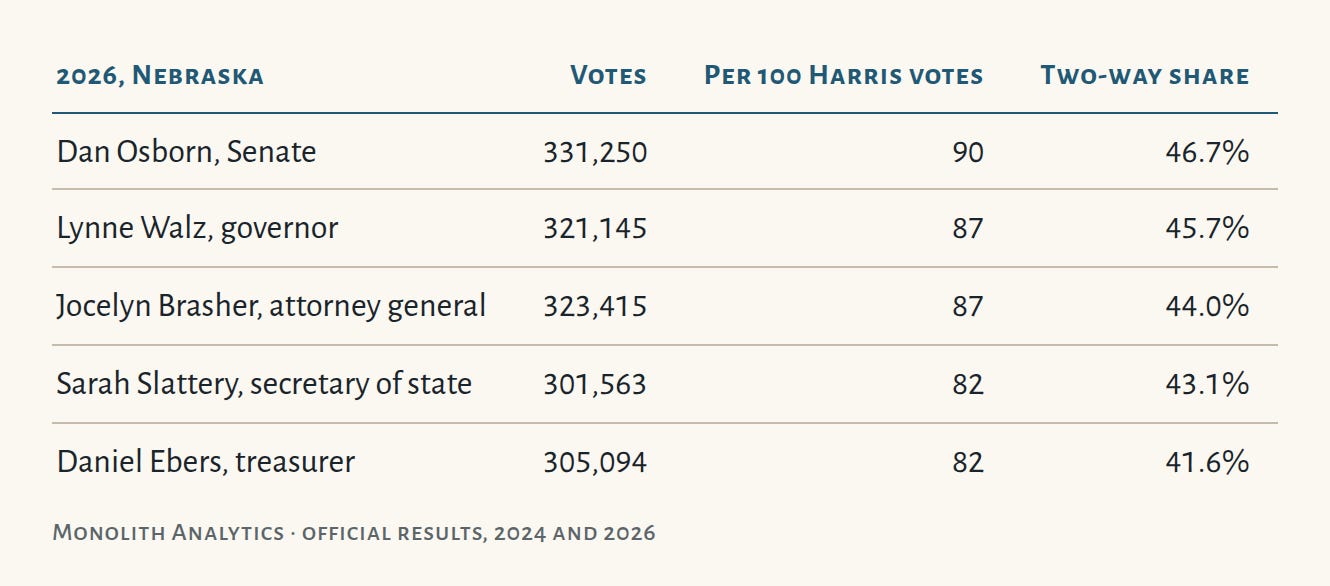
Osborn ran one point ahead of Walz and three to five points ahead of the Democrats lower on the ticket. Where that edge came from shows up district by district, comparing only the precincts that lie wholly inside one congressional district:
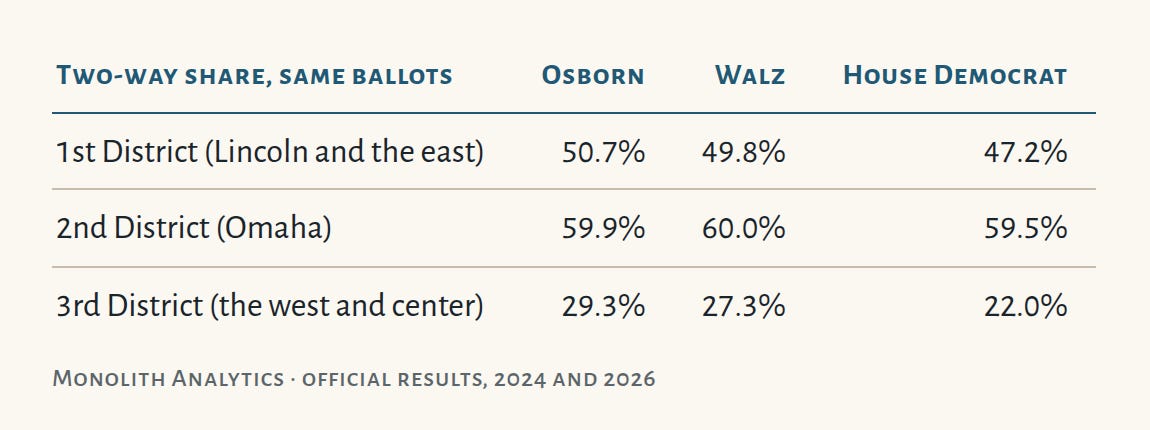
In Omaha, the independent label bought nothing: Osborn, Walz and the Democratic House nominee, Denise Powell, all ran within half a point of each other, and Powell won her seat. Osborn’s edge over Democrats was rural, which is where the crossover strategy aimed. It was also where, compared with Osborn’s own 2024 race, it shrank.
Osborn’s side, with that money behind it, got a competitive loss built on crossover voters outside the cities, but fewer of them than in 2024: Osborn kept 67% of his 2024 vote outside Omaha and Lincoln, while the Republican kept 79%. Statewide, both sides kept 76% of their 2024 vote, which is why Osborn’s share of the two-way vote didn’t move. It didn’t get the city turnout the race needed. In Douglas County, Osborn held 85 votes for every 100 Harris won in 2024; in the poorest fifth of Omaha’s precincts (Douglas and Sarpy), 79. The canvass reached at least one of the poorest neighborhoods in the state, mine. I can’t tell you where else it went, because nothing in the public record says.
Built for one candidate
The literature at my door asked about one race. It’s worth looking at what the same network did for everyone else on the ballot:
Lynne Walz, governor: Way Back PAC gave her campaign $75,000. None of the other groups that funded Working Class Majority PAC spent anything on her race.
The Second District House race: Osborn’s PAC, Way Back PAC and a labor PAC gave the Democratic nominee a combined $20,000 in direct contributions. Working Class Majority PAC spent nothing there.
The Legislature: none of these groups reported spending in a single Legislature race.
The one paid door program that carried another Democrat was Progressive Turnout Project’s, which reported each canvass payment as two equal halves, one for Osborn and one for the House nominee. It came to about $0.7 million in all, a fraction of the program that carried no party at all.
A canvass that leaves a voter with one name and the word “Independent” gives no reason to vote down the ballot. There are reasons an independent’s allies might choose that: a party label can cost crossover votes, and crossover was Osborn’s strategy. But the cost of the choice fell on everyone else on the ballot. In a midterm where Omaha’s Democratic vote fell furthest in its poorest precincts, the largest field program anyone paid for carried nothing for any other race.
What would settle it
Two things will tell us more. The reports due December 3 will show what Working Class Majority PAC and the other groups spent in the campaign’s last three weeks, and every total here will grow; I’ll update this post when they’re in. The state’s 2026 vote history will show voter by voter who came out in neighborhoods like mine. If turnout there rose well above 2022’s, the canvass may have done more than the precinct totals suggest; if it fell like the rest of the city’s poorest precincts, it didn’t.
What it already shows is an accountability gap. A $2.4 million field program for a Senate candidate can be paid for by organizations that don’t name their donors and recorded as an operating cost with no candidate attached, and the voters it was aimed at would never know who paid for it.
Figures run through each committee’s report covering October 14, plus the 24- and 48-hour notices filed through Election Day. Sources: FEC filings, read in full from each committee’s electronic reports (Working Class Majority PAC, C00954503; Working Class Heroes Fund, C00892653; Progressive Turnout Project, C00580068; and every committee that reported spending for or against Osborn). Independent expenditures are counted once each: a 24- or 48-hour notice and the later regular report of the same expenditure are one transaction. FEC Advisory Opinion 2024-01; Campaign Legal Center v. FEC (filed May 6, 2026). Walz figures are from the Nebraska Accountability and Disclosure Commission. Swing and vote-holding figures are from each state’s 2026 county results and the 2024 presidential results. Precinct figures are from my earlier posts.
First published on That's Not How This Works. Subscribe there to get each post by email.